Client
What I did
I was commissioned to write a story about the first ever description of the Coral Community Network, known as the CoCoNet model, to coincide with it being published in Royal Society Open Science.
I interviewed CSIRO’s Dr Scott Condie who modelled 5 interventions aimed at protecting and restoring coral communities on the Great Barrier Reef to see which ones would be most effective at a large scale, under realistic environmental conditions, over the next 50 years.
I took care to emphasise the uncertainties inherent in the modelling and the fact that any intervention without global climate action to reduce emissions will not keep the Reef alive.
I also interviewed Dr Bruce Taylor to learn whether interventions such as cloud brightening would be socially acceptable to Australians.
Buying time for the Barrier Reef – shading coral and controlling starfish show promise at large scale was published in ECOS in 2021.
Shading corals to reduce mass bleaching and expanding the control of coral-eating crown-of-thorns starfish—if socially acceptable and done on a large scale—could buy at least 10 to 20 years for the Great Barrier Reef, according to scientists who have for the first time modelled all of the world’s biggest marine ecosystem.
Modelling showed that these two interventions combined could delay the ecological collapse of the Reef, allowing time for meaningful global action on climate change to take effect.
The delay would also give the Reef more time to adapt naturally to the warming that is already baked into the planet’s climate system.
…
“With intervention, the model suggests we can make a difference for 10 or 20 years. But intervention is not enough if we’re not taking global action in parallel. We need both.” [Dr Scott Condie]
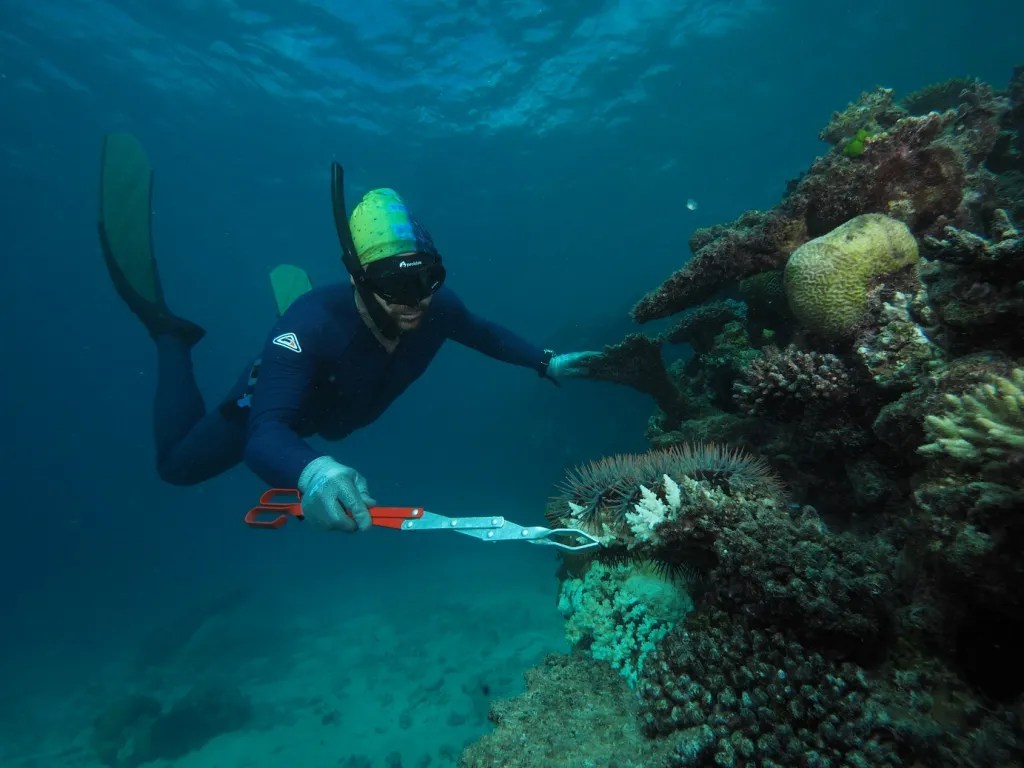
Image: A diver collects a crown-of-thorns starfish for research. Credit: David Westcott, CSIRO
 Mdash Editorial